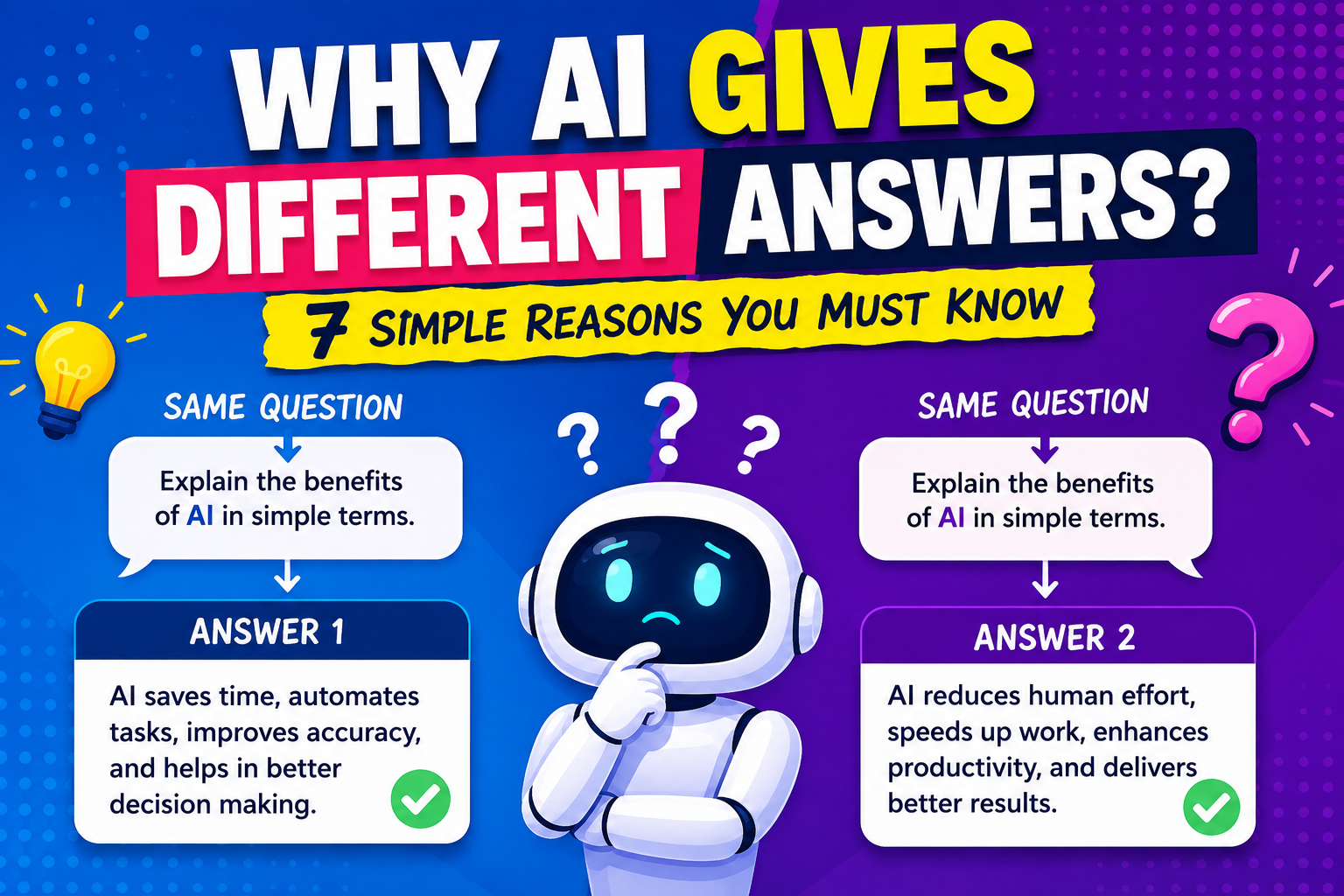
Have you ever asked ChatGPT the same question twice and received two different answers? The first time it sounds brilliant. The second time it misses the point completely. I used to think the AI was simply inconsistent. After months of using ChatGPT, Claude, and Gemini for writing, coding, and research, I realized the problem usually wasn’t the AI—it was the conversation I was having with it.
Why AI Gives Different Answers Isn’t Actually Random
One of the biggest misconceptions is that AI always produces the same output for the same prompt.
In reality, every response depends on context. If your previous messages are different, the AI already has different information before it starts answering.
Even a small change like saying “Explain it simply” instead of “Give me a detailed explanation” can completely change the response.
That’s why Why AI Gives Different Answers isn’t about randomness—it’s about the information you provide.
Small Prompt Changes Create Big Differences
I’ve noticed beginners often compare two answers without comparing the prompts.
For example:
Bad Prompt
Write about SEO.Better Prompt
Write a 600-word beginner-friendly article about SEO using simple English, real examples, and practical tips.Both prompts ask for SEO content, but the second one defines the goal clearly. Better prompts don’t just improve quality—they make results more consistent.
Your Conversation History Matters More Than You Think
Another reason Why AI Gives Different Answers surprises people is memory within a chat.
If you’ve already discussed blogging, the AI may assume you’re still talking about blogging. Start a new conversation, and those assumptions disappear.
Whenever I need an unbiased answer, I usually open a fresh chat. It removes old context and makes it easier to judge the response on its own.
Don’t Expect One Perfect Answer
The biggest lesson I’ve learned is to stop treating AI like a search engine.
Instead of asking one question and accepting the first reply, I refine the conversation.
I’ll ask AI to challenge its own answer, simplify technical sections, or explain the same idea differently. Those follow-up questions often produce the most useful insights.
That’s also why experienced users consistently get better results. They don’t rely on one prompt—they build a conversation.
Final Thoughts
Understanding Why AI Gives Different Answers changes the way you use AI. Instead of blaming the model, start looking at your prompts, your conversation history, and the amount of context you’re providing.
Most of the time, better inputs lead to better outputs. Once you realize that, AI becomes far more predictable—and much more useful.