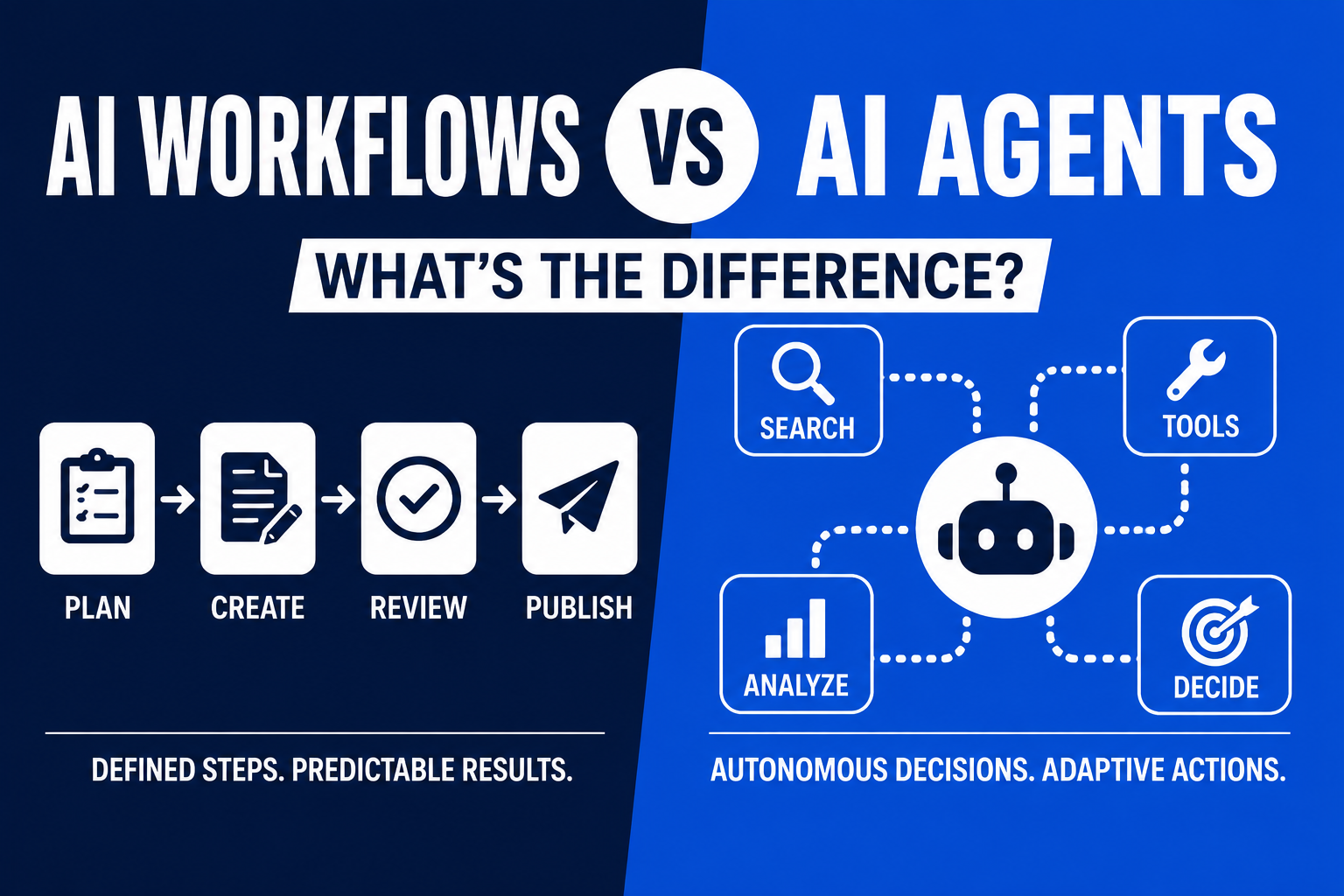
A few months ago, I thought AI Workflows vs AI Agents was just another marketing debate. Every new AI tool claimed to be an “agent,” while YouTube creators used the terms interchangeably. After building content pipelines, automations, and a few experimental agents, I realized the difference isn’t technical—it’s about how much decision-making you hand over to AI. Once that clicked, choosing the right approach became much easier.
AI Workflows vs AI Agents: The Simple Difference
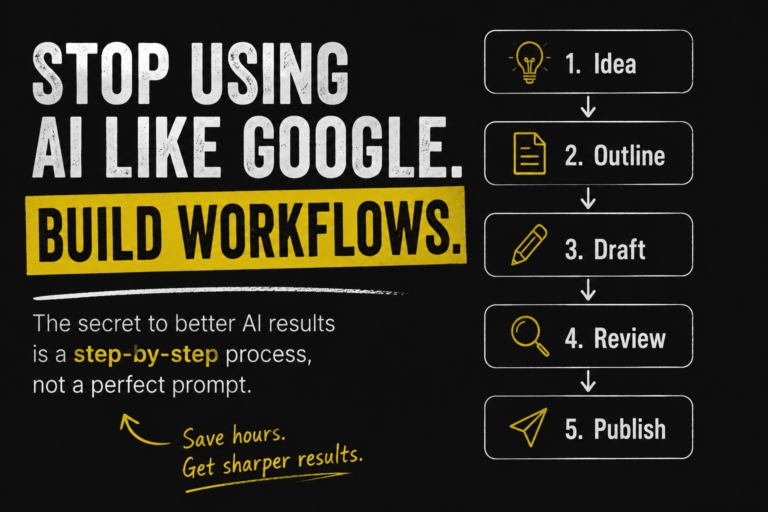
An AI workflow follows a predefined sequence of steps.
For example, I have a content workflow that generates an outline, expands each section, checks grammar, and creates SEO metadata. Every step happens in the same order because I designed it that way.
An AI agent behaves differently.
Instead of following a fixed path, it decides what to do next based on the goal. It may search for information, use tools, retry failed tasks, or even change its own plan without waiting for another instruction.
That’s the biggest difference in the AI Workflows vs AI Agents discussion.
Workflows execute instructions.
Agents make decisions.
When a Workflow Is Actually Better
Many beginners assume agents automatically outperform workflows.
That hasn’t been my experience.
For repetitive jobs like writing article outlines, generating social media captions, renaming files, or summarizing meeting notes, a workflow is usually faster, cheaper, and easier to maintain.
There are fewer moving parts, fewer unexpected outputs, and almost no debugging.
If the process never changes, a workflow is often the smarter choice.
When AI Agents Start Making Sense
Agents become valuable when every task is different.
Imagine asking AI to research competitors, compare pricing, visit multiple websites, summarize findings, and prepare a report.
You don’t want to write separate prompts for every step.
An agent can decide which tools to use, gather missing information, and adjust its approach when something fails.
That’s where AI Workflows vs AI Agents becomes less about features and more about solving the right problem.
The Mistake I See Most Often
The biggest mistake isn’t choosing the wrong AI model.
It’s building an agent for work that only needs a workflow.
I’ve seen creators spend days connecting tools and configuring agents for tasks that could have been completed with a simple five-step automation.
Complexity feels exciting, but it also creates more opportunities for errors.
Whenever possible, start with a workflow. If you repeatedly find yourself making decisions between steps, that’s usually the signal it’s time to build an agent instead.
Final Thoughts
The conversation around AI Workflows vs AI Agents often makes agents sound like the future of everything. In reality, both have their place.
If your process is predictable, build a workflow.
If your problem requires reasoning, adaptation, and tool selection, an AI agent is worth exploring.
The goal isn’t to use the most advanced technology. It’s to choose the simplest approach that consistently gets the job done