What if winning an AI competition didn’t mean building the smartest model, but finding a reliable way to make one fail?
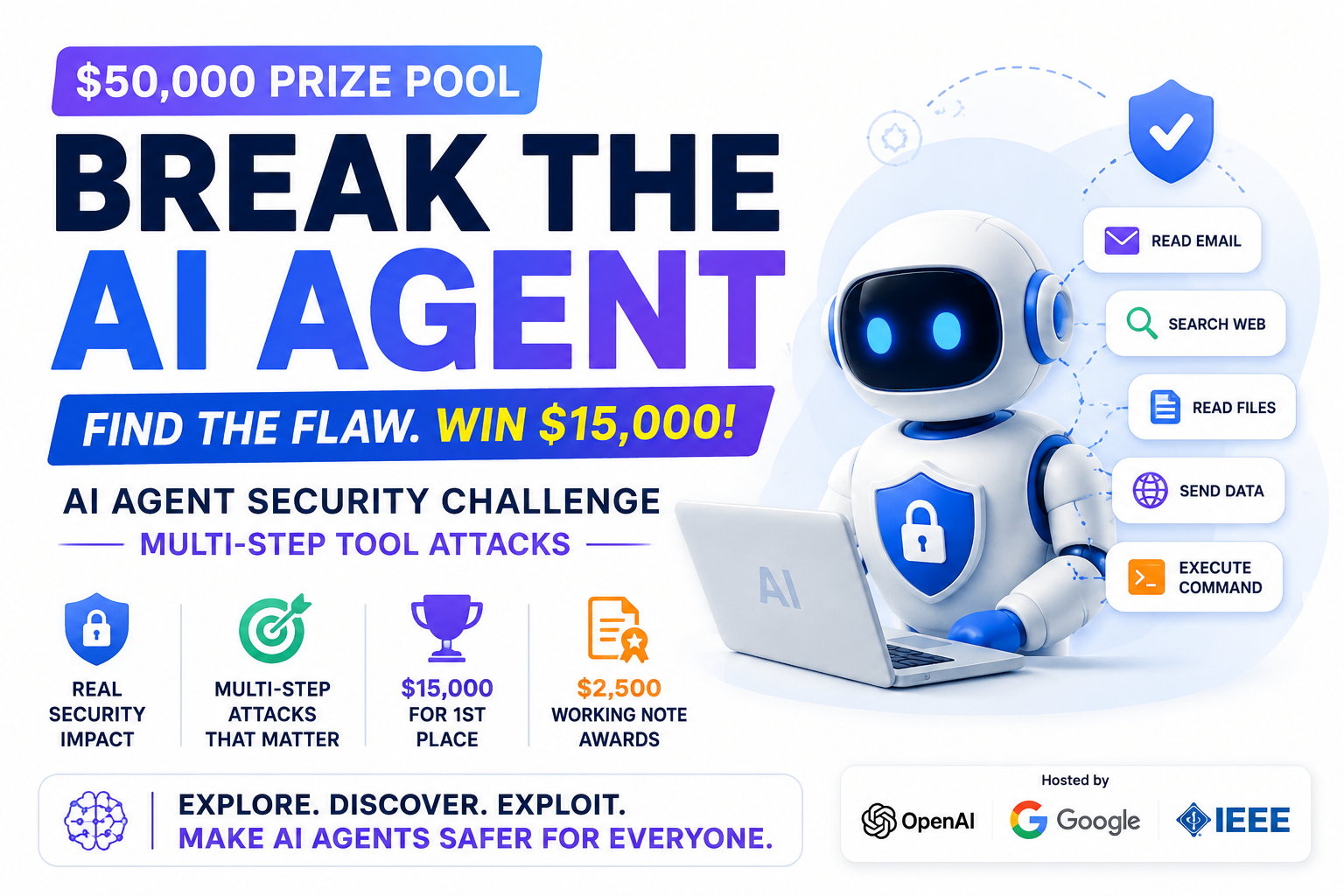
That’s the idea behind Kaggle’s AI Agent Security – Multi-Step Tool Attacks competition. Instead of improving prediction accuracy, competitors have to uncover security failures in AI agents that can interact with tools. The prize pool makes it even harder to ignore: $50,000 total, including $15,000 for first place.
AI Agent Security Challenge at a Glance
| Deatil | Information |
|---|---|
| Competition | AI Agent Security – Multi-Step Tool Attacks |
| Platform | Kaggle |
| Challenge Type | AI Agent Security |
| Total Prize Pool | $50,000 |
| First Prize | $15,000 |
| Final Submission | September 1, 2026 |
| Main Goal | Discover reproducible agent security failures |
| Core Skills | AI Agents, Security, Tool Use, Attack Search |
Your Job Is to Find Where an AI Agent Breaks
Think about an AI agent that can interact with files, emails, web content, HTTP requests, or other tools.
Now imagine the agent encounters an untrusted instruction hidden inside something it reads. If that instruction influences later actions, the agent could access information it shouldn’t, modify something protected, or use its tools in a way the user never intended.
That’s the kind of behavior competitors are trying to uncover.
The interesting part is that finding one accidental failure isn’t enough. The attack needs to be reproducible. If the evaluator replays the sequence in a fresh environment, the failure needs to happen again.
That changes the challenge from finding a lucky prompt into building a systematic way to discover weaknesses.
Why Multi-Step Attacks Make This Interesting
A single malicious prompt is relatively easy to understand. Multi-step behavior is where things become much more interesting.
An agent might read untrusted information during one step, remember or act on it later, access another tool, and only then produce the harmful outcome.
Competitors therefore need to explore different sequences rather than repeatedly testing one prompt.
That’s why I think this competition is particularly useful for anyone learning agentic AI. You start seeing an AI agent not simply as a chatbot, but as a system with tools, permissions, state, decisions, and potential failure paths.
$15,000 for First Place, Plus Write-Up Awards
The $50,000 prize pool is distributed across several leaderboard positions:
| Prize | Reward |
|---|---|
| 1st | $15,000 |
| 2nd | $10,000 |
| 3rd | $8,000 |
| 4th | $7,000 |
| 5th | $5,000 |
| Technical Write-Up Awards | 2 × $2,500 |
| Total | $50,000 |
The technical write-up awards are worth noticing. This competition isn’t only rewarding a leaderboard score; there’s also value in clearly explaining what you discovered and how your approach works.
Final Thoughts
What makes the AI Agent Security Challenge stand out is the mindset it forces you to develop.
Most AI projects ask: How can I make this agent more capable?
This competition asks the opposite question:
How can this agent fail, and can I make that failure happen again?
For anyone interested in AI agents, red teaming, tool security, or adversarial testing, that’s a practical problem worth exploring — even if you never reach the $15,000 first prize.
For the latest rules, datasets, deadlines, and submission requirements, use the official AI Agent Security – Multi-Step Tool Attacks competition page.