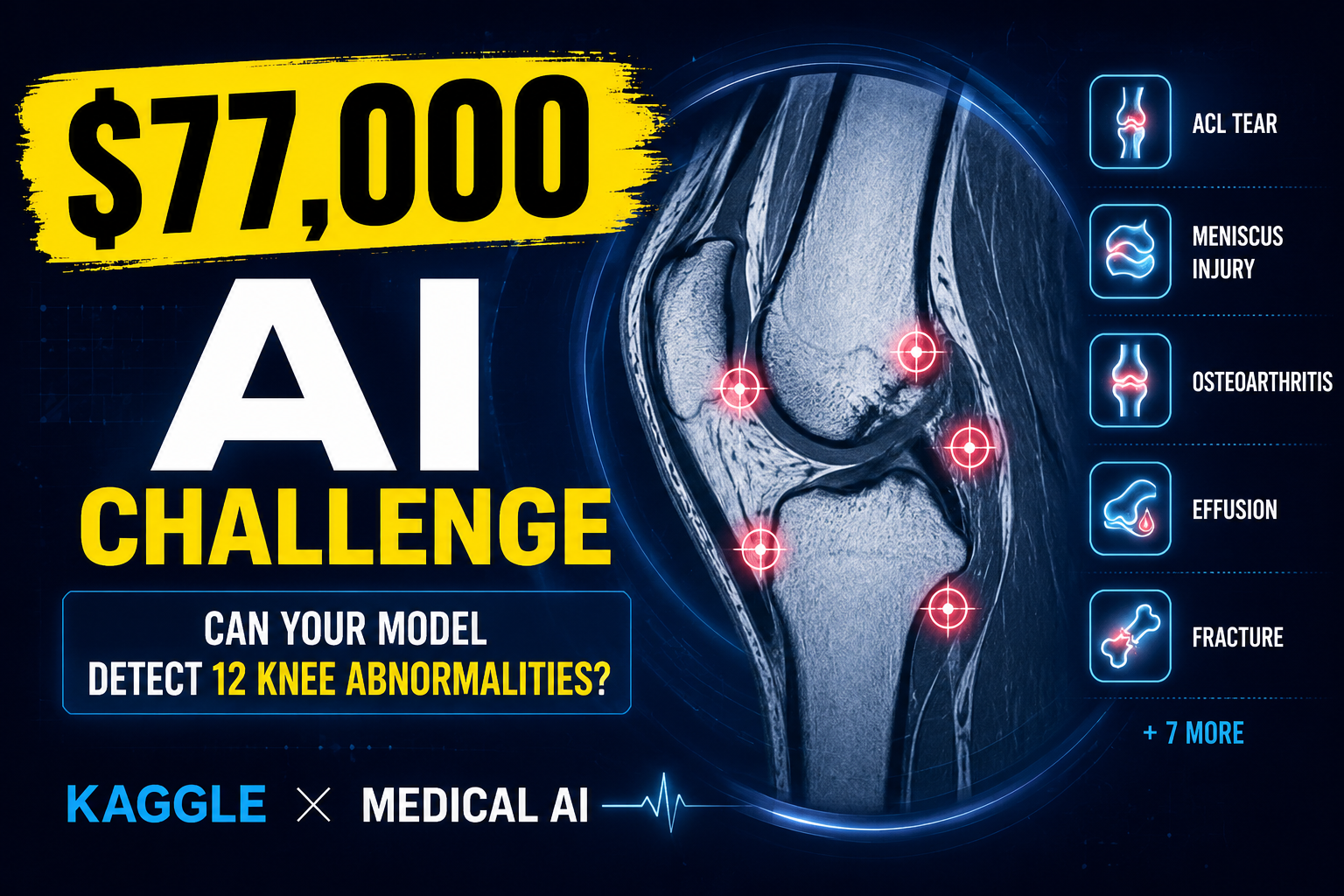
A knee MRI can hide an ACL tear, cartilage damage, a fracture, or several other problems in the same scan. Now Kaggle is turning that diagnostic challenge into a $77,000 machine learning competition. The new RSNA Knee Abnormality Detection challenge asks participants to detect 12 clinically important abnormalities using both MRI images and radiology reports. And unlike a typical playground competition, the winning models could point toward something genuinely useful in healthcare.
RSNA Challenge at a Glance
| Feature | Details |
|---|---|
| Prize Pool | $77,000 |
| Targets | 12 abnormalities |
| Entry Deadline | October 15, 2026 |
| Final Deadline | October 22, 2026 |
| Submission | Kaggle Notebook |
| Tracks | Leaderboard + Efficiency |
$77,000 Is Up for Grabs — With Two Ways to Win
The prize structure makes this competition particularly interesting.
The main leaderboard pays the top 10 teams, with $9,000 for first place. But RSNA and Kaggle have also created a separate Efficiency Track worth $18,000, rewarding models that combine strong predictive performance with practical runtime.
That matters because medical AI isn’t very useful if an accurate model requires unrealistic computing resources to run.
A submission can potentially qualify for both tracks.
You’re Not Just Classifying One Knee Problem
This isn’t simply an ACL-tear detector.
Models need to predict confidence scores for 12 abnormalities, including ACL and MCL injuries, medial and lateral meniscus damage, osteoarthritis, effusion, synovitis, Baker’s cyst, contusion, and fracture.
What caught my attention is the dataset itself. According to the competition description, this is the first RSNA AI Challenge dataset pairing every imaging study with its original radiology report.
That opens the door to multimodal approaches combining medical images with diagnostic text rather than treating MRI scans in isolation.
The Deadline Looks Comfortable, but the Rules Aren’t
The competition started on July 30, 2026.
Participants must join and accept the rules by October 15, while final submissions close on October 22, 2026.
There is one technical constraint worth noticing before jumping in: this is a Kaggle Code Competition. Submissions must come through notebooks, internet access is disabled, and both CPU and GPU notebooks have a maximum runtime of nine hours.
Publicly available pretrained models and external data are allowed.
Winning Means More Than Reaching the Leaderboard
There’s another unusual part of this challenge.
Winners are expected to provide their training code, method description and a short presentation video. They must also make their code and model weights publicly available for distribution and validation.
Winners will be invited to the RSNA Annual Meeting AI Challenge Recognition Event, with the event fee waived subject to the stated requirements.
Prizes:
| Prize Category | Prize Amount |
|---|---|
| First Prize | $9,000 |
| Second Prize | $7,500 |
| Third Prize | $6,500 |
| Fourth Prize | $6,000 |
| Fifth Prize | $5,500 |
| 6th–10th Prize | $5,000 each |
| Efficiency Track Pool | $18,000 |
| Efficiency 1st Prize | $7,000 |
| Efficiency 2nd Prize | $6,000 |
| Efficiency 3rd Prize | $5,000 |
| Total Prize Pool | $77,000 |
Final Thoughts
The RSNA Knee Abnormality Detection competition stands out because there are really two problems to solve: accuracy and efficiency.
For experienced computer vision or multimodal ML teams, the $77,000 prize pool is an obvious hook. For everyone else, the combination of MRI imaging, radiology text and strict compute limits makes this an interesting competition to follow even if you never reach the podium.
Ready to Compete?
View the Official RSNA Knee Abnormality Detection Competition on Kaggle →RSNA Knee Abnormality Detection | Kaggle