What if your next Kaggle competition wasn’t about predicting house prices or classifying images, but teaching an AI to run an entire farm?
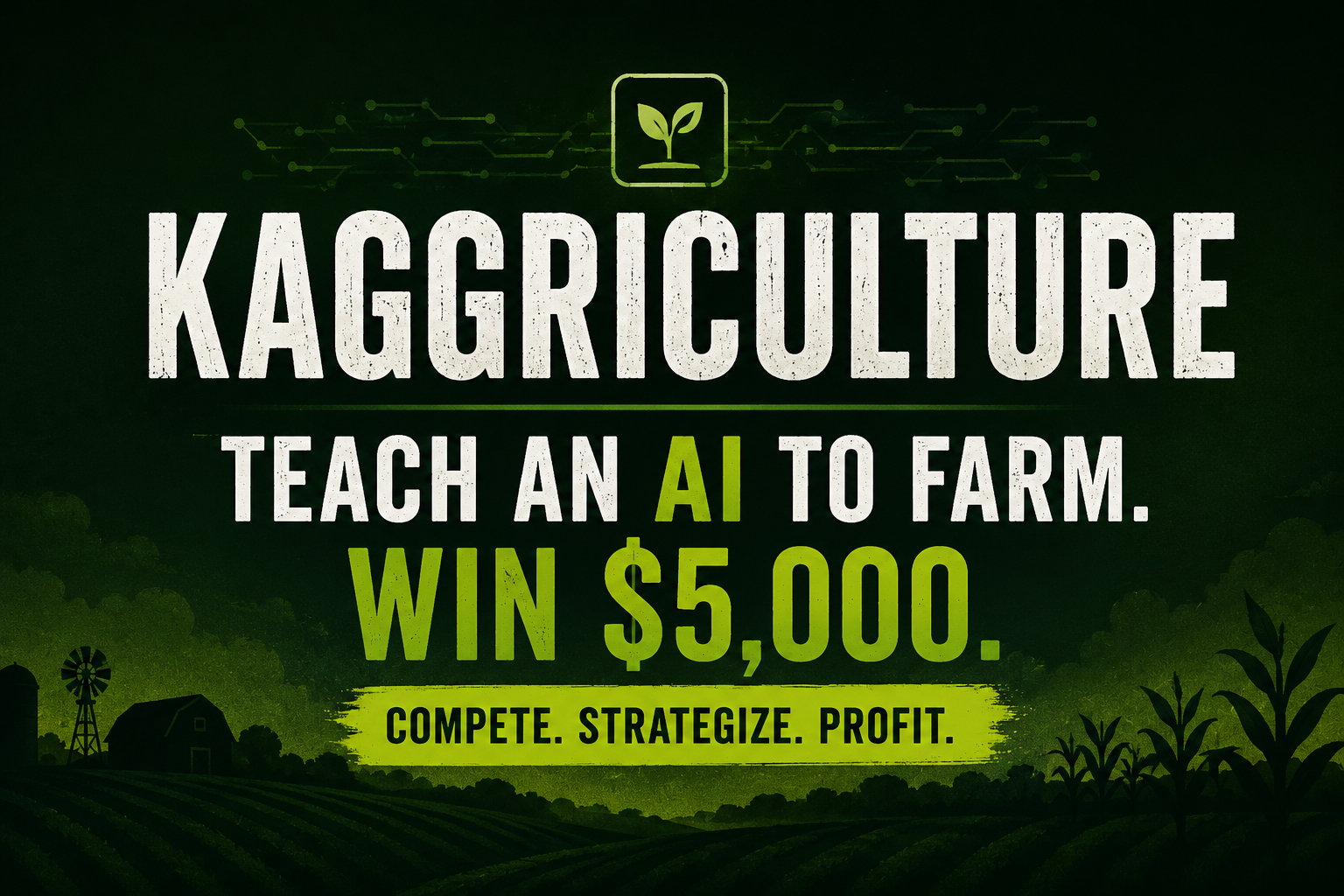
That’s the idea behind Kaggriculture, where your AI agent has to make decisions about crops, animals, workers, land, and trading. And there’s a serious reason to pay attention: $50,000 in total prize money, with $5,000 going to each of the Top 10 teams.
Kaggriculture at a Glance
| Detail | Information |
|---|---|
| Competition | Kaggriculture |
| Platform | Kaggle |
| Challenge Type | AI Agent / Farming Simulation |
| Total Prize Pool | $50,000 |
| Prize per Winning Team | $5,000 |
| Prize Positions | Top 10 Teams |
| Main Goal | Maximize your farm’s income |
| Core Skills | AI Agents, Strategy, Planning, Optimization |
| Best For | AI agent builders and Kaggle competitors |
Kaggriculture Isn’t a Normal Kaggle Competition
The first thing that caught my attention about Kaggriculture was how different the problem feels.
In a typical machine learning competition, you train a model, make predictions, check the score, and try to squeeze out another improvement.
Here, your AI has to make decisions.
During the simulated farming season, your agent has to decide how to use its resources while dealing with crops, animals, workers, land, and a marketplace where conditions can change.
That creates an interesting problem: a decision that makes money now might hurt the farm later.
Instead of asking, “How accurate is my model?” you’re effectively asking, “What should my agent do next?”
$50,000 Makes the Top 10 Worth Chasing
The prize structure is another reason Kaggriculture stands out.
There’s $50,000 in total prize money, divided equally among the Top 10 teams.
| Result | Reward |
|---|---|
| Total Prize Pool | $50,000 |
| 1st–10th Prize | $5,000 each |
That means you don’t have to finish first to win money. Reaching the Top 10 is enough for a $5,000 prize.
Of course, that doesn’t make it easy. Competition on Kaggle can get intense, especially once strong teams start refining strategies.
But having ten prize positions gives competitors something more realistic to chase than a winner-takes-most structure.
Why AI Agent Builders Should Pay Attention
The farming theme might make Kaggriculture look like a game. Underneath it, though, the challenge is much closer to the problems people face when building autonomous AI systems.
Your agent needs to plan across multiple steps, allocate limited resources, react to changing conditions, and balance short-term rewards against longer-term outcomes.
That’s why I think Kaggriculture is useful even for someone who doesn’t win.
Building a strategy, watching it fail, figuring out why, and improving the decision logic gives you practical experience with agent behavior that’s difficult to get from another AI tutorial.
Kaggle itself describes simulation competitions as environments where competitors train bots to navigate environments, which is a useful distinction from standard prediction competitions.
Final Thoughts
The $50,000 prize pool is what gets attention, but the real appeal of Kaggriculture is the problem itself.
You’re not building an AI that simply answers a prompt. You’re trying to build an agent that can plan, act, adapt, and make better decisions over time.
If you’re interested in agentic AI, simulation, optimization, or strategy, Kaggriculture is the kind of competition worth experimenting with.
Ready to Compete?
Check the latest rules, deadlines, eligibility, and submission requirements directly on Kaggriculture | Kaggle